
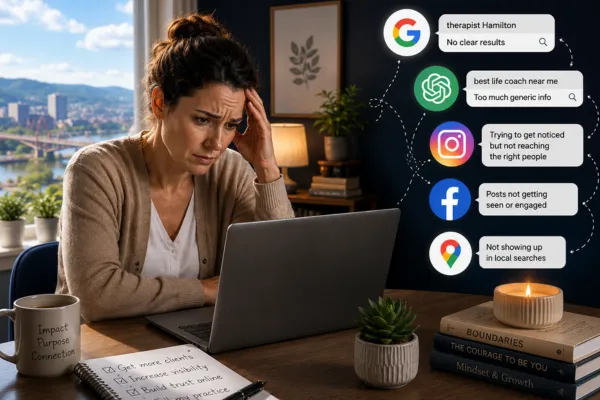
Why Hamilton Therapists and Life Coaches Struggle to Get Found Online
- Clients searching for a therapist in Hamilton now start on Google, browse directories like Psychology Today, and increasingly ask AI platforms for recommendations before ever reaching out.
- According to Google, 46% of all searches have local intent, which means most people looking for a Hamilton therapist are searching for a local provider right now.
- A Psychology Today profile alone is not enough. Trust is built after a client clicks through to your own website, not inside a directory listing.
- A Modern Discovery Audit identifies your practice's specific visibility gaps and documents the fix within 14 days.
Your practice is built on trust. That trust is not just part of your brand, it is the reason clients choose you in the first place. When someone books a therapy session or reaches out to a life coach, they are making a deeply personal decision. They want to feel safe, understood, and supported before they ever send an inquiry.
The problem is that many of the people looking for support in Hamilton never find the right practitioner online. Not because those therapists or coaches are unqualified, but because their online presence does not reflect the level of trust, warmth, and expertise they bring to their work. Hamilton therapists and life coaches struggle to get found online because clients now search Google, browse directories, and ask AI platforms for recommendations before contacting anyone, and a thin or incomplete online presence gets skipped in favour of the next name on the list.
Today, the client journey starts online. People search Google late at night when anxiety feels overwhelming. They browse therapist directories during lunch breaks. They watch mental health content on Instagram and TikTok while trying to decide whether therapy might help them. More recently, they are even asking AI platforms for recommendations on therapists and coaches in their area. If your practice is difficult to find, or if your online presence feels incomplete, potential clients will often move on before ever contacting you.
Why Trust-Based Practices Have a Different Marketing Challenge
Trust Takes Time to Earn
Marketing a therapy or coaching practice is very different from marketing a fitness studio or wellness clinic. A potential client is not casually exploring a new hobby. They are deciding whether to trust someone with deeply personal experiences, emotions, and challenges. That decision usually comes after weeks or even months of hesitation and internal debate.
Because of that, trust matters more than almost anything else online. People are looking for signals that help them feel comfortable reaching out. They want to know what kind of person you are, how you approach therapy or coaching, and whether they will feel understood in your space.
When Referral Networks Plateau
Many therapists in Hamilton still rely heavily on referrals and directory listings. While referrals remain valuable, they are no longer enough on their own. Once referral networks plateau, growth slows down because new clients are searching online first. If your website, Google presence, and content do not immediately build confidence, people often continue searching until they find someone who does. If that sounds like where your practice is right now, you are not alone, and it is fixable.
How Therapy Clients Search for Help Today
The Search Patterns Clients Follow
Most clients follow a similar path when searching for a therapist or life coach in Hamilton. They usually begin with Google searches like "anxiety therapist Hamilton," "psychotherapist Hamilton Ontario," "life coach near me," or "couples counselling Hamilton." According to Google, 46% of all searches have local intent, and therapy searches are almost always among them.
From there, they compare websites, reviews, and directory listings. This is the exact moment where your website either earns their trust or loses them to the next name on the list. At this point, they are not necessarily ready to book. They are trying to get a sense of who feels trustworthy and relatable.
Directories like Psychology Today still play an important role, especially for therapists across Ontario, alongside professional bodies like the Canadian Counselling and Psychotherapy Association. The challenge is that every practitioner looks very similar inside a directory listing. Credentials and specialties alone rarely create a meaningful connection. That is why your website matters so much. Clients want to see content that feels human and specific to what they are experiencing.
Social Media and AI Search Are Reshaping Discovery
Social media also plays a growing role in mental health marketing. Educational Instagram posts, thoughtful LinkedIn content, and short-form videos help therapists and coaches build familiarity before a client ever reaches out. At the same time, AI-driven search is changing how recommendations happen online. Platforms like ChatGPT and Perplexity pull information from websites, Google Business Profiles, directories, FAQs, and published content. Practices with a stronger online presence are more likely to appear in those recommendations.
Why a Psychology Today Profile Is No Longer Enough
The Limits of a Directory Listing
Having a Psychology Today profile is important, but it should not be your entire online strategy. When potential clients browse therapist directories, they often see dozens of professionals with similar qualifications and descriptions. Without a stronger online presence connected to that profile, it becomes difficult to stand out.
What Builds Trust After the Click
What builds trust is the experience clients have after they click through to your website. A strong therapy website speaks directly to the concerns people are already struggling with. It explains your approach clearly and uses language that feels compassionate rather than clinical. Your online presence should help answer questions clients are already asking themselves: What happens in the first session? What if I feel nervous? How do I know therapy is working? Is this therapist the right fit for me? When your website answers those questions naturally and clearly, clients begin building trust before they ever contact you.
The Kind of Content That Builds Trust Online
The best content for therapists and life coaches is not overly promotional. It is thoughtful, educational, and grounded in real client concerns. For example, a blog post explaining what a first therapy session feels like can reduce fear and uncertainty for someone considering therapy for the first time. A FAQ page that addresses common worries around confidentiality, emotional vulnerability, or treatment expectations helps clients feel safer reaching out.
Location-specific pages such as "Anxiety Counselling Hamilton Ontario" also help your practice appear in local SEO for small businesses in Ontario while speaking directly to the experiences potential clients are having. Good content accomplishes three things at once: it builds trust, it answers objections, and it improves visibility on Google and AI platforms. That combination is what helps turn online searches into real inquiries.

What Search Everywhere Optimization Looks Like for Therapists
The Channels That Matter Most
Search Everywhere Optimization means creating visibility across every platform where people search for support. For therapy and coaching practices, that includes Google search, Google Business Profile, therapist directories, Instagram and LinkedIn, AI search platforms, and blog content and FAQs. Your Google Business Profile is one of the most important pieces. An updated profile with professional photos, accurate services, reviews, and occasional posts helps establish credibility quickly.
Your Website's Job Is to Solve Problems, Not List Credentials
Your website should focus less on listing credentials and more on describing the problems you help people solve. A page about anxiety counselling should sound like it was written for someone experiencing anxiety, not for another practitioner. Even occasional social media content can help build familiarity and trust over time. You do not need to become an influencer to stay visible. Consistency and authenticity matter far more than volume.
How Wondering Concierge Helps Hamilton Therapy Practices Grow
At Wondering Concierge, we understand that therapy and coaching brands are deeply personal. Your marketing should feel like an extension of your voice and values, not a generic template copied from another industry. That is why we begin with a Modern Discovery Audit. We review how visible your practice is across Google, AI platforms, directories, and social search, then identify the biggest gaps affecting your ability to attract new clients.
In a typical first audit for a therapy or coaching practice, we find three to five specific issues: an online presence that stops at a Psychology Today listing, a website that leads with credentials instead of client concerns, no schema markup, or a social account that has gone quiet for months.
From there, we help practices improve visibility in a way that still feels authentic, professional, and trust-centred. Because in mental health marketing, visibility alone is not enough. People need to feel safe choosing you before they ever reach out. And that starts with being found in the first place.
The first step is not a pitch. It is a Modern Discovery Audit. We identify exactly what is keeping your practice invisible and show you the fix, in writing, within 14 days.
If we do not find your number-one gap and document it with measurable proof, you pay nothing for Month 1. Book Your Clarity Call We work with a maximum of six clients at a time.Frequently Asked Questions
Can a psychotherapist in Hamilton grow their practice through SEO?
Yes, and it is more powerful for therapy practices than most practitioners realize. The people searching for a therapist in Hamilton are in a high-intent, high-need state. They have made a significant internal decision to seek help. A therapy practice that appears at the right moment in that search, with content that builds trust quickly, will convert those searches into bookings at a high rate. The challenge is that most Hamilton therapists have minimal SEO presence beyond a Psychology Today listing, which means the bar to standing out is lower than in more competitive niches.
What content builds trust for a mental health or life coaching brand online?
The highest-trust content for therapy and coaching practices addresses the specific struggles your clients are facing, describes your approach in plain language, removes fear and ambiguity about what working with you is like, and answers the real questions clients have before they reach out. FAQ pages, first-session descriptions, specialty-specific blog posts, and authentic social content that demonstrates your thinking all build trust faster than credentials lists or service menus.
How do therapy clients in Hamilton search for a new therapist?
Most searches are condition or concern-specific: "anxiety therapist Hamilton," "trauma counselling Hamilton Ontario," "life coach for burnout Hamilton," or "couples therapy Hamilton." Some are modality-specific: "EMDR therapist Hamilton," "CBT therapy Hamilton." And an increasing number are conversational AI queries: "Who is a good therapist in Hamilton for anxiety?" Your content needs to match all of these patterns, not just your professional title.
Is social media appropriate for promoting a psychotherapy or life coaching practice?
Yes, with the right approach. The most effective social content for therapists and coaches is educational and insight-driven, not promotional. A post that explains a common anxiety pattern, offers a simple reframe for a coaching concept, or normalizes a mental health experience builds trust and reach simultaneously. Instagram and LinkedIn are the highest-return platforms for most Hamilton therapists and coaches. TikTok is worth considering for coaches who serve younger audiences.
This blog collection is written by Miles Harding and the Wondering Concierge team for the benefit of readers to be able to grow their business and get found online by more of their dream customers. The team includes human members with learned / lived experiences and expertise, as well as trained AI team members who assist with the creation and publication of this blog content. The team monitors Google and other guidelines for continued knowledge to help with SEO and AI usage. If you have any questions regarding the humans in the loop and how AI is used to follow these guidelines, contact Wondering Concierge at [email protected].