How to Build a Consistent Brand Voice in Hospitality
In short: A consistent brand voice holds because it is documented, not remembered. Name three to five brand traits, turn them into writing rules, and apply them across your website, emails, review responses, and social. Consistent brand presentation can increase revenue by up to 23%, because guests read consistency as trust before they ever book.
- Consistent brand presentation can increase revenue by up to 23%, according to Marq. In hospitality, it shows up in ADR tolerance, direct booking rate, and guest loyalty.
- Most inconsistency happens because the voice lives in the founder's head and never gets documented for the team.
- Guests compare your website, emails, reviews, and social before booking. When those sound different, the trust that drives booking decisions erodes quietly.
- A documented voice guide, built from three to five brand traits, is what makes consistency scalable without requiring your oversight on every piece of content.
Your property is distinctive. The experience you have built has taken years and real investment to develop. Guests who visit love what you have created, and a handful of them have told friends. By every internal measure, the work is good.
But somewhere between your Instagram caption and your booking confirmation, something shifts. The tone on your website sounds polished and confident. Your emails read a bit corporate. Your review responses sound like they were written by a different person entirely. And somewhere on your social feed, there is a post that sounds nothing like you at all.
Guests notice this more than you might think. Not consciously, the way they would notice a broken elevator. But in a quieter way that shapes first impressions and second-guess moments. When your voice does not hold across touchpoints, the trust you have worked hard to build starts to erode. The guest who was 80% convinced to book starts wondering whether the experience will actually match what you are selling.
That inconsistency is costing you bookings. Here is what is actually happening, and how to fix it.
Why Brand Voice Consistency Directly Affects Revenue
The Revenue Impact
Research cited by Marq reports that consistent brand presentation can increase revenue by up to 23%. In hospitality, that number is not abstract. It shows up in conversion rate, ADR tolerance, add-on uptake, and the difference between a guest who books direct versus one who books through a third party because the OTA listing somehow felt more polished than your own site.
The reason is straightforward: consistency signals reliability. When your tone, messaging, and promises show up the same way across your website, social channels, emails, and on-property communications, guests feel more confident the experience will match expectations. That confidence is a form of trust, and trust drives real loyalty behaviours.
The Trust Premium
Qualtrics research found that trust correlates strongly with repeat bookings and word-of-mouth recommendations, with a correlation coefficient of .67. Salsify separately found that many guests will pay a premium for brands they trust. In hospitality, that trust premium shows up as higher ADR tolerance, better direct booking rates, and guests who forgive the occasional service hiccup rather than posting a negative review.
For boutique operators competing without full marketing teams, voice consistency is one of the few advantages you can actually control. You cannot outspend a regional chain on advertising. But you can absolutely out-voice them.
Where Boutique Hospitality Brands Actually Fall Apart
How the Voice Splinters Across Your Team
Most inconsistency does not happen because owners do not care. It happens because the voice lives in one person's head and never gets documented.
The founder writes the website copy and the first email templates. Then a seasonal hire takes over Instagram. A front-desk manager starts responding to reviews. A contractor writes the pre-arrival message. Suddenly four different voices are representing the same brand, each doing their best but none working from the same reference point.
Why the Gap Is More Visible Than Ever
Shiji's 2025 Guest Experience Benchmark reported global guest satisfaction at 86.9% in Q2 2025. As satisfaction expectations rise across the industry, inconsistency becomes more visible. Guests are comparing you to the best experience they have had anywhere. When your website promises one thing and your emails deliver a different tone, the gap creates doubt before they ever arrive.
And it compounds online. In 2026, potential guests are not just reading your website before booking. They are reading your Google reviews, checking your Instagram, asking AI platforms for recommendations, and comparing your digital presence against competitors who may be investing more deliberately in how their brand shows up. An inconsistent voice does not just lose one booking. It reduces your conversion rate across every platform your guests use to make their decision. Brand clarity and search visibility need to work together, not separately, which is part of what we address in Search Everywhere Optimization.
What Guests Actually Experience Across Your Touchpoints
Guests do not experience your brand in departments. They move through it. Your website, booking confirmation, pre-arrival message, on-property signage, and post-stay email are not separate channels. They are one continuous story, and guests read all of it before they even arrive.
| Touchpoint | Guest mindset | Voice goal | Tone cues |
|---|---|---|---|
| Website homepage | "Is this for me?" | Clarity and emotional pull | Confident, vivid, guest-centred |
| Booking confirmation | "Did it work?" | Reassurance and precision | Clear, friendly, organized |
| Pre-arrival email | "Help me plan" | Anticipation and usefulness | Warm, concise, proactive |
| On-property signage | "What do I do?" | Simplicity and calm | Direct, respectful, minimal |
| Review response | "Do they care?" | Accountability and humanity | Gracious, specific, non-defensive |
When each of these touchpoints sounds like the same brand, the overall experience feels elevated, even when individual elements are simple. When they sound different, excellent service can still feel disjointed, because the narrative is not holding together.

How to Build a Brand Voice That Actually Holds
Name Your Brand Traits First
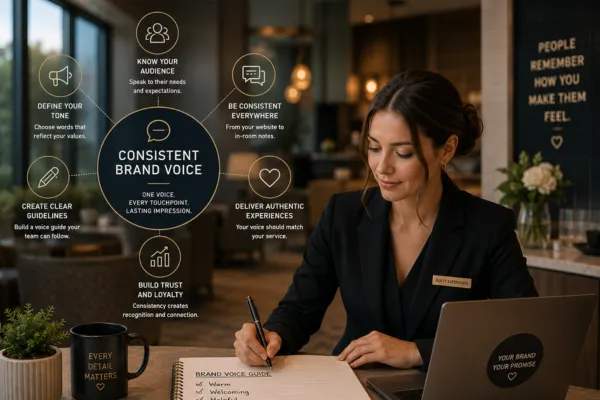
The first step is naming the voice before writing a word. Start with three to five brand traits that describe how your brand should feel in a guest's mind. Examples: welcoming, calm, refined, playful, local, efficient, family-oriented. Then translate those traits into writing rules your team can actually use:
- Words you use often and why
- Words you avoid and why
- Sentence style (short and direct versus lyrical and sensory)
- Formality level (polished versus conversational)
- How you handle apologies and service recovery
Turn Traits Into a Working System
These rules become a voice guide, and the voice guide is what makes consistency scalable. Marq's brand governance research describes this as the system of rules and guardrails that keeps brands consistent as more people create content. In hospitality, where seasonal turnover is high and communications come from multiple sources, that system is not optional. It is what protects the guest experience you have worked hard to build.
A practical way to get started: audit your last ten guest-facing communications for tone consistency, identify the two or three places where the voice slips most noticeably, and build templates for those touchpoints first. Review responses and booking confirmations are usually the highest priority. Then schedule a quarterly review to check that the voice is holding as your team and campaigns evolve. For boutique retreat and resort operators, how micro resorts build direct booking visibility shows how brand clarity and discoverability work together in practice.
How Wondering Concierge Helps Boutique Brands Sound Like Themselves
This is exactly the kind of work Miles Harding and the Wondering Concierge team specialize in. Not writing generic copy that makes every property sound the same, but doing the harder thing: uncovering what makes your brand distinct and building the systems that let that voice show up consistently without requiring your personal oversight on every piece of content.
We work with boutique hospitality and wellness brands specifically because we understand the guest decision journey, and our work connects brand clarity directly to booking outcomes. We are not here to make you sound good in theory. We are here to make you findable, recognizable, and worth choosing every time a guest is comparing you to the competition. That is the difference between marketing that looks good and marketing that actually converts.
The first step is not a pitch. It is a Modern Discovery Audit. We identify exactly what is breaking your brand consistency and your online visibility, and we show you the fix, in writing, within 14 days.
If we do not find your number-one gap and document it with measurable proof, you pay nothing for Month 1. Book Your Clarity Call We work with a maximum of six clients at a time.Frequently Asked Questions
How do I identify my brand voice?
Start by naming three to five traits that describe how your brand should feel in a guest's mind, then translate those traits into writing rules: words you use, words you avoid, sentence style, and formality level. Your voice should reflect what you can reliably deliver across every touchpoint, not an aspirational script that breaks down under the pressure of daily operations. Marq's brand consistency research shows that clarity and repeatability are what make a voice sustainable over time.
How can I ensure my team uses the brand voice consistently?
Create a practical voice guide with real examples, train guest-facing and content-creating team members together, and build templates for high-frequency messages like confirmations, pre-arrival emails, and service recovery responses. Marq's brand governance framework emphasizes that workflows and guardrails, not just documentation, are what keep brands consistent as more people create content.
Why does cross-channel consistency matter for bookings?
Because guests naturally compare every touchpoint before they commit, and they use consistency as a signal of reliability. Qualtrics research found that trust correlates strongly with repeat bookings and word-of-mouth recommendations. When your website, emails, and review responses all sound like the same brand, that consistency compounds into trust, and trust converts browsers into guests.
How does brand voice affect my online visibility?
Directly. AI platforms like ChatGPT and Perplexity synthesize recommendations from your website content, Google Business Profile, reviews, and any published material about your property. When your voice is clear, specific, and consistent across all of these sources, the AI has more to work with and is more likely to recommend you. This is part of what our Search Everywhere Optimization work addresses for hospitality brands.
What makes Wondering Concierge different from a brand agency?
Most brand agencies deliver a strategy document and leave. Wondering Concierge is built around implementation. We work with boutique hospitality and wellness brands specifically because we understand the guest decision journey, and our work connects brand clarity directly to booking outcomes. We are not here to make you sound good in theory. We are here to make you findable, trustworthy, and worth choosing every time a guest is comparing you to the competition.