Guest Journey Mapping for Hotels| Turn Insight Into Bookings
In short: Guest journey mapping visualizes the full guest experience across every stage, from discovery to post-stay follow-up, so a hotel can see what guests need at each step and fix where the path breaks. Done well, it sharpens website copy and turns scattered touchpoints into a clear path to a direct booking, which is worth far more to a property than a third-party reservation.
- Guest journey mapping visualizes every stage of the guest experience, from discovery to post-stay, so teams can fix friction and answer guest questions before they slow a booking.
- The average hotel website converts at under 2%, which means every headline, room description, and policy page has to earn the reservation.
- Direct bookings are worth more than 60% higher revenue per reservation than OTA bookings, so on-site clarity is commercially significant, not just tidy.
- Map by guest segment, not averages: a weekend couple, a family, a wellness traveller, and a business guest arrive with different priorities and different questions.
Most hospitality websites are trying to do two jobs at once: inspire the stay and remove friction from the booking decision. That is harder than it sounds, especially when conversion rates stay low. Across the industry the average hotel website converts at under 2%, with one benchmark putting a typical hotel group at around 1.9%. Numbers like that make every headline, room description, policy page, and booking step matter.
Guest journey mapping gives hospitality brands a practical way to improve both experience and revenue at the same time. Instead of writing from the brand's point of view alone, teams map what guests are trying to understand at each stage, from discovery to post-stay follow-up. The result is sharper messaging, fewer unanswered questions, and a clearer path from interest to reservation.
Here is what belongs on the map, and how to turn it into website copy that actually books.
Why Guest Journey Mapping Belongs in Hotel Marketing
A hotel website is not one decision. It is a sequence of small ones: is this right for my trip, does this room fit, can I trust this rate, what happens if my plans change. When the site answers those questions in the order guests ask them, the path to booking feels effortless. When it does not, guests hesitate, open three competitor tabs, and often drift to an online travel agency that simply felt more organized.
That drift is expensive. Guest journey mapping is the discipline that closes the gap between what a property is proud of and what a guest actually needs to know before they commit. It reframes the website from a brochure into a decision tool, and that reframing is where conversion rates start to move.
What the Guest Journey Actually Includes
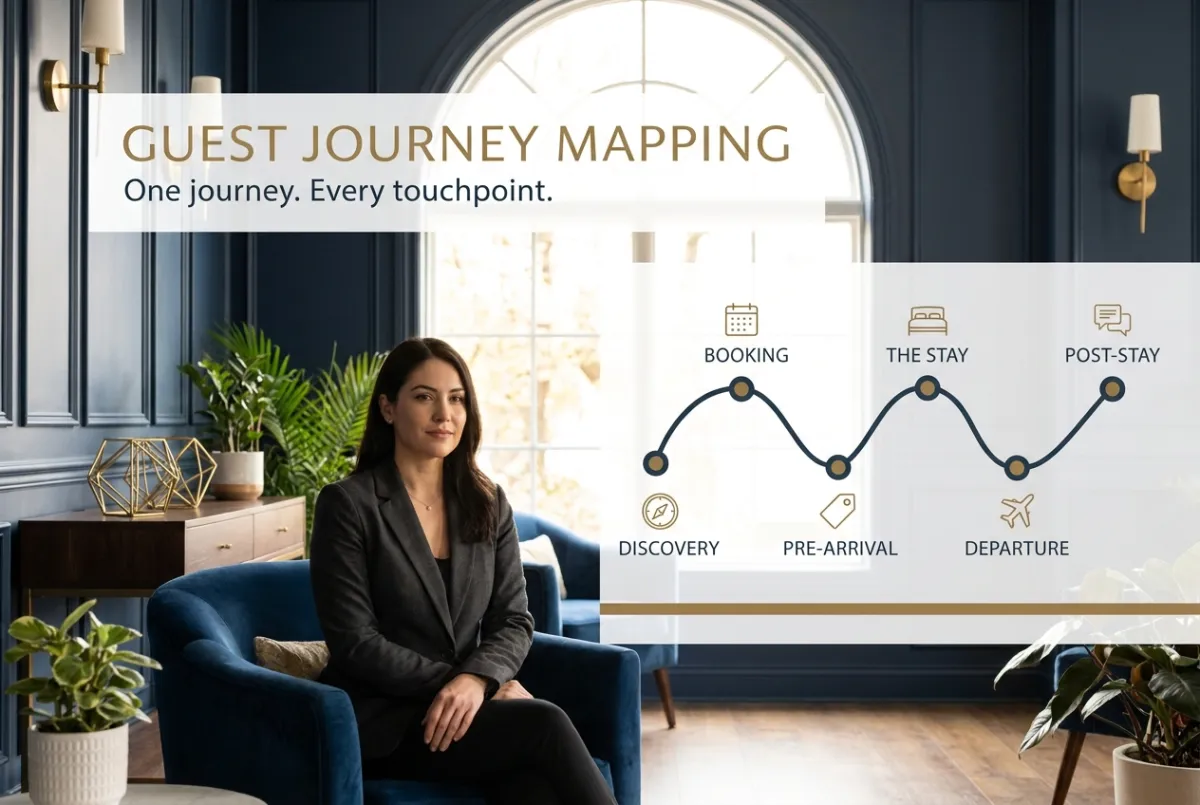
Definition, guest journey mapping: a structured way to visualize the full guest experience across every touchpoint, from discovery and booking through pre-arrival, the stay, departure, and post-stay follow-up, capturing what guests feel, what they need answered, and where the experience breaks down at each stage.
A strong map does more than list stages. It records the emotion and the open question at each step, because that is what tells you which piece of content or which service response is missing.
How to Build a Useful Map
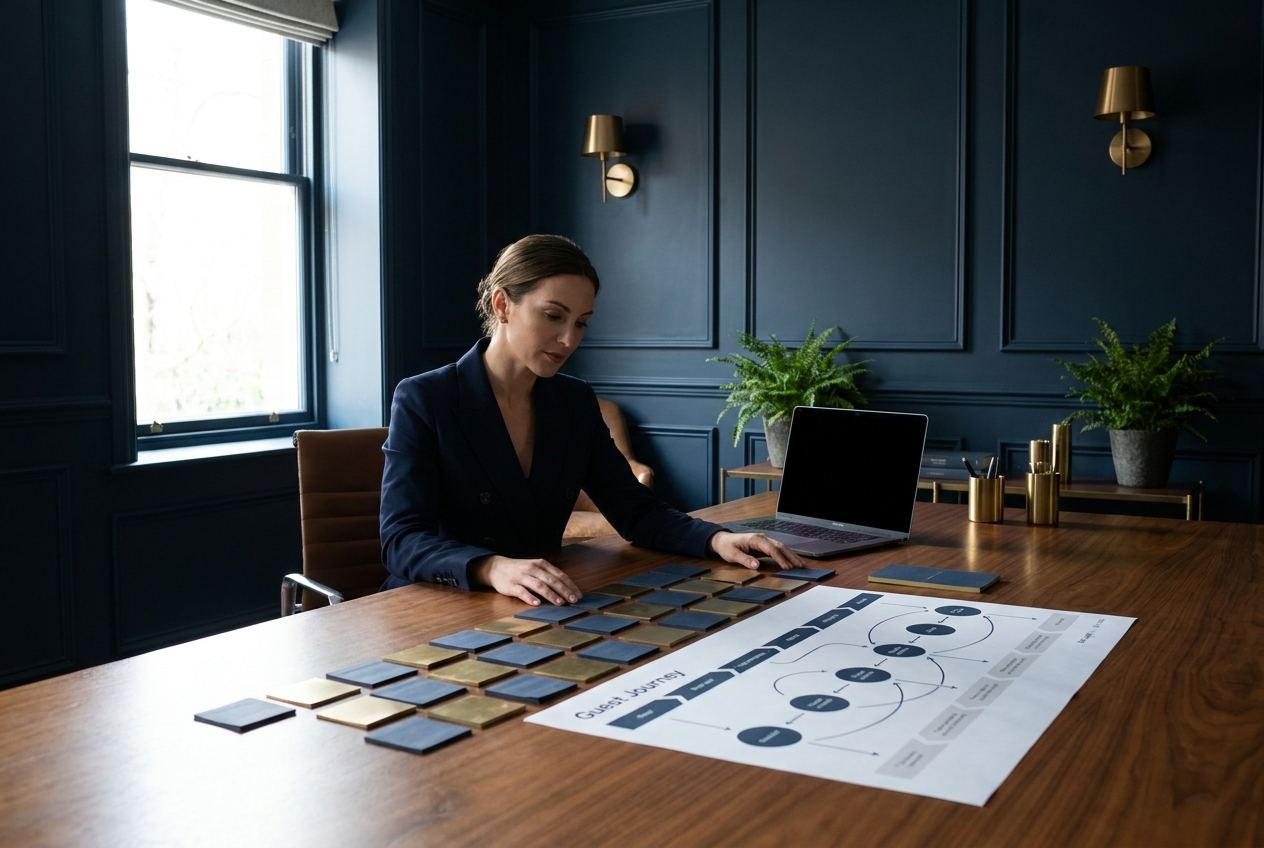
A practical journey map starts with segments, not averages. A weekend couple, a family, a wellness traveller, and a business guest often arrive with completely different priorities. Once those personas are defined, list the stages they move through, then document four things at each one:
| Journey stage | Guest question | Common friction | Content or service response |
|---|---|---|---|
| Discovery | Is this right for my trip? | Generic positioning | Clear value proposition by trip type |
| Consideration | What makes this property fit? | Missing specifics | Room, amenity, and location details |
| Booking | Can I trust this offer? | Confusing rates or policies | Transparent pricing and cancellation terms |
| Pre-arrival | What do I need before check-in? | Sparse communication | Arrival email, directions, parking, timing |
| In-stay | How do I make the most of this? | Service gaps | On-site guidance, upsell clarity, local tips |
| Post-stay | Should I return or recommend it? | No follow-up | Review request, loyalty prompt, return offer |
The most effective maps are updated with real evidence: booking drop-off points, review patterns, common support questions, and front-desk feedback. That is where the map stops being a workshop exercise and starts becoming an operating tool.
Turning Guest Insight Into Stronger Website Copy
A guest journey map quickly reveals how often hospitality websites lead with vague promises while guests are looking for specifics. Before booking, people usually want answers to practical questions: Where exactly is the property? Is parking easy? What time is check-in? Are pets allowed? Is the spa adults-only? Are the family suites actually spacious enough? What happens if plans change?
What Better Copy Looks Like
Good website copy answers those questions early, in plain language. Instead of promising an unforgettable escape, the page should explain what kind of stay it suits and why. "Quiet lakefront rooms with private balconies," "walkable access to downtown dining," or "two-bedroom suites for longer family stays" gives the reader something usable. The specific version does the persuasion the vague version only gestures at.
This is also where journey mapping supports direct booking performance. A hotel has the most control on its own website, especially over pricing, messaging, and booking conditions. When those elements are clear, the website does more of the persuasion work before the guest ever reaches the booking engine. Getting the words right across every touchpoint is the same discipline we cover in building a consistent brand voice in hospitality.
How Strategic Messaging Drives More Direct Bookings
Better messaging is not just a brand exercise. It affects channel mix, conversion quality, and revenue. SiteMinder's 2025 booking trends report found that hotel websites generated more than 60% higher revenue per booking than online travel agencies, roughly US$516 direct versus US$320 through an OTA. That makes direct reservations commercially significant, not just operationally convenient.
When teams map the journey well, their copy starts addressing objections before those objections slow the booking. Rate pages explain value instead of listing prices in isolation. Room pages match real trip intent. Policy language reduces uncertainty instead of creating it. Pre-arrival emails reassure guests instead of forcing them to call. Each improvement is small on its own, but together they create a smoother decision path and shift the channel mix toward the reservations a property keeps the most margin on.
What Ontario Hotels Should Look For in Marketing Support
Ontario hotels often need more than attractive copy alone. The most useful marketing support combines guest journey mapping, website messaging, SEO fundamentals, and technical visibility, because discoverability now depends on both what a page says and how clearly search systems can interpret it.
Services That Connect Visibility and Conversion
Structured data is one example. Google's hotel pricing documentation states that Hotel and HotelRoom structured data in JSON-LD helps validate pricing information for Google Hotels. In practice, that means content strategy and technical setup should work together, especially for properties that want stronger direct-booking visibility. For many Ontario properties, the most valuable mix includes customer journey mapping, website copy refinement, local and organic search optimization, booking-path review, and content planning tied to real guest intent rather than generic tourism language.
A Sharper Approach for Boutique and Wellness Brands
Boutique and wellness hospitality brands rarely win on sameness. They compete on atmosphere, emotion, purpose, and fit. That makes journey mapping especially valuable, because it forces clarity on what the property is truly selling. Is it privacy, restoration, design, ritual, calm, or convenience? If the answer shifts from page to page, guests feel the inconsistency even when they cannot name it, and independent properties feel it most, since they have less brand recognition to fall back on.
Writing for Search, Discovery, and AI-Assisted Planning
Search behaviour is also changing. Google explains that AI Overviews help people find and synthesize information from multiple sources more quickly. For boutique and wellness brands, that raises the bar for clarity: content needs to be specific enough for a traveller to trust and structured enough for search systems to interpret. In practice that means descriptive page titles, unambiguous service details, strong location context, and copy that reflects actual traveller intent. Broad lifestyle language may sound polished, but it performs poorly when it never explains the offer in concrete terms. This is the same principle behind Search Everywhere Optimization: be legible to guests and to the systems recommending you.
How Wondering Concierge Helps Hotels Map the Journey
This is exactly the work we look at first. Not whether a website looks attractive, but whether it answers the right question at the right stage of the guest's decision. In a typical Concierge Brand Audit for a hospitality or wellness brand, we usually find the property is excellent and the website is simply speaking a stage behind the guest, inspiring the stay on a page where the guest is trying to confirm a rate, or staying quiet on a page where they need reassurance.
We map the journey by segment, find the touchpoints where guests hesitate, and rebuild the copy and structure so the site does the persuasion before the booking engine ever loads. The goal is not a prettier website. It is a booking path a guest trusts, because everything they find answers the question they are actually asking.
Frequently Asked Questions
What is guest journey mapping?
Guest journey mapping is the process of visualizing the guest experience across every touchpoint, from discovery and booking to the stay and post-stay follow-up, so teams can identify guest needs, friction points, and improvement opportunities at each stage.
What are the stages of the hotel guest journey?
A typical hotel guest journey moves through discovery, consideration, booking, pre-arrival, the in-stay experience, departure, and post-stay follow-up. At each stage the guest carries a specific question, and mapping those questions shows exactly where website copy or service needs to improve.
How does improved website copy increase bookings?
Clear copy reduces uncertainty. It answers real guest questions, reinforces value, and makes it easier to book directly without leaving gaps around rooms, policies, amenities, or fit. When the website resolves objections early, more of the persuasion happens before the guest reaches the booking engine.
How does guest journey mapping support direct bookings over OTAs?
Direct bookings are worth more than 60% higher revenue per reservation than OTA bookings, according to SiteMinder. Journey mapping strengthens the messaging, pricing clarity, and booking conditions a hotel controls on its own site, which shifts more reservations to the higher-margin direct channel.
Which services help Ontario hotels improve online visibility?
The strongest support usually combines guest journey mapping, website copy strategy, local and organic SEO, structured data implementation, and booking-path optimization, so the site is easier to find and easier to book from across both traditional search and AI-assisted discovery.
The first step is a free 30-minute Clarity Call. No pitch deck. You'll leave with at least one clear observation about where your brand is losing visibility or momentum, and one direction for what to fix first.
Miles runs every Clarity Call personally, with no obligation to continue after the call. Book Your Clarity Call Our deepest tier, an embedded strategic marketing partnership, is reserved for six founders at a time.This blog collection is written by Miles Harding and the Wondering Concierge team for the benefit of readers to be able to grow their business and get found online by more of their dream customers. The team includes human members with learned / lived experiences and expertise, as well as trained AI team members who assist with the creation and publication of this blog content. The team monitors Google and other guidelines for continued knowledge to help with SEO and AI usage. If you have any questions regarding the humans in the loop and how AI is used to follow these guidelines, contact Wondering Concierge at [email protected].