

How to Get More Customer Reviews Without Extra Work
In short: You get more customer reviews without extra work by asking once, at the right moment, through a message that sends itself. Find the point where your clients are happiest, send one short, honest request with a direct Google review link the day after their visit, and let the system remember what a busy front desk might overlook.
- Most clients will leave a review if you ask. BrightLocal's 2026 survey found 83% of people who were asked to leave a review went on to leave one.
- Timing matters more than effort. Ask once, after the client has had time to enjoy the experience, usually the next day.
- Give the job one owner and one request. Remove the duplicate asks coming from your front desk, your email platform and your booking system.
- Ask for an honest review, never a positive one. Rewards for reviews break Google's rules, and misleading reviews can create liability under Canada's Competition Act.
- Recent reviews count most. BrightLocal found 74% of consumers only care about reviews written in the last three months.
You know your clients love you. They rebook, they send their friends, and they tell you at the front desk that it was the best massage they've had in years. Then you open your Google Business Profile and see the same 23 reviews you had last spring. It feels like you are doing everything right and getting no credit for it.
Most boutique hotels, wellness businesses, and restaurants don't have a review problem because their guests are unhappy. They have one because nobody asks at the right moment, or because the request depends on a busy front desk remembering to do it between the phone, the card machine and the next client walking in. If you want to get more customer reviews without extra work, the answer is building one well-timed request into your client journey, so it happens consistently without having to chase people again and again.
This guide covers how to audit the experience, remove the small things that stop people from finishing a review, choose the right tools, and set up a review request system that still feels personal.
Why reviews matter more than they used to
Your next client reads recent reviews first
Reviews have always mattered, but the bar for "recent" has moved. BrightLocal's 2026 Local Consumer Review Survey of US consumers found that 74% only care about reviews written in the last three months. A wall of glowing reviews from 2023 may tell a new client that you used to be great, and leave them wondering about now.
The same survey has some good news for you. 78% of consumers were asked to leave feedback for a business in the past year, and 83% of people who were asked went on to leave a review. Your clients are willing. Most of the time, they are simply waiting to be asked in a way that takes them less than a minute.
AI tools summarize your reviews before anyone reads them
BrightLocal also found that 82% of consumers read AI-generated review summaries, and 23% would be willing to rely on that summary alone to make a decision. That summary is only as good as what it is built from. A steady flow of recent, detailed reviews gives it something real to say about you. AI search such as ChatGPT and Gemini is beginning to earn people's trust as a source in its own right, and this is why every place your reviews live matters so much.
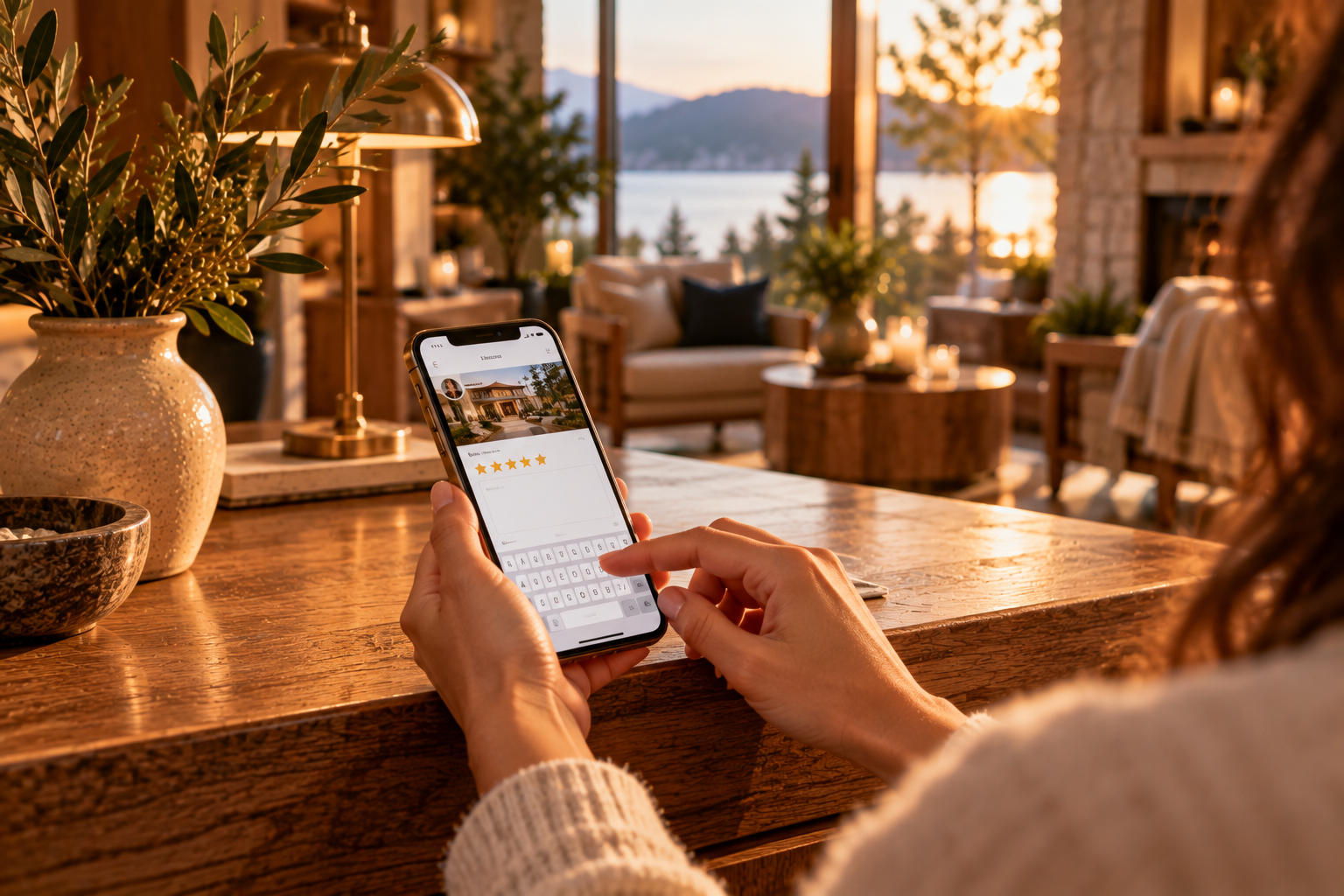
Your reviews travel further than Google
This is the idea behind Search Everywhere Optimization: your brand should show up clearly wherever people look, on Google, in Maps, in AI assistants and in social search. Reviews sit in the middle of all of it. A client may first see your star rating in Google Maps, read your reviews again on a booking site, and then ask ChatGPT which spa in town is best for a couples' visit.
Google is clear that reviews feed local search. Its own guidance on how to improve your local ranking says that "more reviews and positive ratings can help your business's local ranking," and that replying to reviews "shows that you value their feedback." So a simple review routine does two jobs at once. It reassures the person reading, and it gives search engines and AI tools fresher proof that your business is active and well liked. If you want the bigger picture, our guide on how local SEO and your Google Business Profile shape AI recommendations walks through how these pieces connect.
Audit before you automate
Automating a messy process only makes the mess happen faster. Spend an afternoon looking at what your clients already receive from you before you sign up for any software.
Map the guest journey
The guest journey is the full path from booking or appointment to arrival, service, checkout and post-visit follow-up. Write down each step and note where satisfaction tends to peak. For a hotel, that is often the morning after checkout. For a health and wellness business, it is usually a few hours after the appointment, once the client is home and relaxed. For a physio or chiropractic clinic, it may be after the visit where a client first notices they can turn their head or climb stairs without wincing. For a restaurant, it might be shortly after the meal. A review request feels natural at these points because your client has had time to judge the experience while it is still fresh.
Next, list every place where you already communicate with your clients: booking confirmations, receipts, text reminders, Wi-Fi welcome pages and loyalty emails. Many businesses find that two or three people are asking the same client for a review. Reception hands over a card, marketing sends an email, and a booking platform sends its own prompt. Pick one owner and one main request, and remove the rest. Our guide to guest journey mapping for hotels shows how to lay this out step by step.
| Moment in the visit | Good for a review request? | Why |
|---|---|---|
| Booking confirmation | No | The guest hasn't experienced anything yet |
| Arrival or check-in | No | Asking this early feels rushed and transactional |
| Receipt or checkout | Sometimes | Works with a QR code, but the guest may be in a hurry |
| Thank-you email the next day | Yes | Timely, thoughtful and easy to act on |
| Text message follow-up | Yes, with consent | Fast and easy on a phone |
| Loyalty messages | Occasionally | Best as a gentle second reminder |
Fix the small barriers and the voice
Check the basics before you pay for new tools. Your Google Business Profile, the listing where customers leave Google reviews, should be complete and accurate, with current hours, real photos and every service listed. Open your review link on your own phone and count how many taps it takes. Decide who replies to reviews and how quickly. If you plan to send text messages, confirm that you have recorded consent, because Canada's anti-spam legislation (CASL) asks businesses to get consent before sending commercial electronic messages, including texts.
Then read every client-facing message out loud, one after another. Do they sound like the same business? Your clients will likely notice the jump from a warm welcome note to a stiff, templated review request. When your story and tone carry through every message, an automated message reads like part of your hospitality and not like a form letter. Our piece on building a consistent brand voice in hospitality covers how to keep that tone steady.
Build the low-lift system
Once the journey is clean, automation can handle the repeat work for you.
Automate the right request
Definition, review request system: an automated workflow that sends a message after a visit or purchase asking the client for an honest review, with a direct link to the review form.
Connect it to your booking system, point-of-sale, CRM (your customer database) or email platform so the request goes out on its own after checkout. Add a short delay so the client has time to get home first. We usually suggest 12 to 24 hours, then adjust once you see when people respond.
Google lets businesses create a review link or QR code and suggests sharing it on receipts, in thank-you emails, at the end of a chat and on printed signs in your space. Use that direct link so your clients go straight to the review form instead of hunting for it. Offer email and text where you have permission, and use whichever channel the client booked through.
When you compare tools, look at five things:
- Connections to your booking, point-of-sale, CRM or email tools
- Consent settings for email and text opt-ins
- Custom wording so the message sounds like you
- Reporting on delivery, opens and review volume
- Reply management so your team can answer reviews from one place
Keep requests neutral and within the rules
Ask for an honest review, never a positive one. Google's policy on prohibited content bans offering "payment, discounts, free goods and/or services" in exchange for a review, and it also bans selectively asking only happy customers. It also says businesses should not pressure people to leave a rating while they are still on the premises, so a QR code on the counter is an invitation, not a request at the till.
In Canada, the Competition Bureau has warned businesses that anyone who writes or permits reviews that give a false or misleading impression could be liable under the Competition Act. That includes staff reviewing their own workplace without saying so. A discount offered "for a five-star review" may break both sets of rules at once.
Why a competitor may be getting the booking
It can feel unfair. A newer studio down the street, with less experience and a smaller team, keeps showing up ahead of you. Often the difference is not quality. It is that their reviews are recent, their replies are personal, and their profile looks cared for.
Replies count more than most owners expect. BrightLocal's 2026 survey found 89% of consumers expect business owners to respond to reviews, and 19% expect a reply the same day. A two-line reply that thanks a client by first name and mentions the facial or the room they stayed in shows the next reader that someone is listening. A row of unanswered reviews may tell them the opposite, even when your care is excellent.
The good news is that this gap is usually about routine, not reputation. Our piece on why chiropractors lose patients to competitors online shows how the same pattern plays out in one corner of health care.
A worked example and common pitfalls
What it looks like in practice
Picture a 24-room boutique hotel in Ontario. At 9 a.m. the morning after checkout, its system sends a short thank-you email signed by the general manager. One button opens the hotel's Google review form. A second line invites the guest to reply directly if anything fell short. The platform tracks deliveries and responses, so staff only step in when someone raises a real concern. Nobody at the front desk has to remember anything.
The same idea works for a wellness clinic. A massage therapy practice can send a short text the evening after a first appointment, from the therapist's name, with one link and one honest question: "How did today feel?" It takes your team zero extra minutes per client once it is set up.
Mistakes to avoid
Even a well-built system can backfire if you:
- Ask before the client has experienced the service
- Send three or four reminders when one follow-up at most is enough
- Steer unhappy clients away from public review sites, a practice called review gating
- Buy reviews or reward particular ratings
- Use the same wording for every location, service and type of client
For more ideas on asking for reviews and replying to them, Google's own tips to get more reviews are a useful companion to this guide.
How Wondering Concierge sets up a review routine
We don't treat reviews as a separate project, because your clients don't experience them separately. A review routine touches your brand voice, your Google Business Profile, your booking tools and your search visibility all at once. It usually starts with our Concierge Brand Audit, where we map your client journey, find the moment your clients are happiest, and spot where duplicate or badly timed requests are getting in the way.
From there, the work draws on the service lines that match what we find: Google Business Profile management so your profile is complete and every review gets a personal reply; CRM and marketing automation so the request sends itself from your booking or point-of-sale system; brand strategy so the message sounds like you and not like software; and Search Everywhere Optimization so your reviews support how you show up on Google, in Maps and in AI tools.
One thing we see on almost every first call: the request already exists, but it goes out at the wrong time, from a no-reply address, with a link to the homepage instead of the review form. Fixing those three details is often the quickest win in the whole engagement.
Audit first, then automate
You get more customer reviews without extra work by understanding the journey before adding tools. Find the moment your clients are happiest, send one timely request in your own voice that stays within the rules, and let the system handle the consistency. At Wondering Concierge, we've found that the businesses with the healthiest review profiles rarely ask the hardest. They ask once, warmly, at the right time.
The outcome to aim for is easy to measure: new reviews arriving every month without anyone chasing them, and a fuller calendar from people who trusted what they read. If your reviews have gone quiet, a Clarity Call is the right place to start.
How do I get more customer reviews without extra work?
Set up one automated message that goes out the day after a visit, with a direct link to your Google review form. Send it from a real person's name, ask for honest feedback, and give the job to one owner so clients aren't asked three times.
When is the best time to ask a client for a review?
After they have had time to enjoy the result, but while it is still fresh. For most hotels, spas and clinics that is 12 to 24 hours after the visit. Asking at booking or check-in is usually too early.
Can I offer a discount or gift for a Google review?
No. Google bans payment, discounts and free goods or services in exchange for reviews, and it bans asking only happy clients. In Canada, misleading reviews can also create liability under the Competition Act. Ask for honest feedback instead.
Do I need permission to send review requests by text in Canada?
Usually, yes. Canada's anti-spam legislation (CASL) asks businesses to get consent before sending commercial electronic messages, including texts. Record consent at booking and include a way to opt out in every message.
Do reviews help my business show up in AI search like ChatGPT?
They can. AI tools read the same reviews and business listings people do, and many people now read AI review summaries before deciding. Recent, detailed reviews with personal replies give those tools a clearer picture of your business.
The first step is a free 30-minute Clarity Call. No pitch deck. You'll leave with at least one clear observation about where your brand is losing visibility or momentum, and one direction for what to fix first.
Miles runs every Clarity Call personally, with no obligation to continue after the call. Book Your Clarity Call Our deepest tier, an embedded strategic marketing partnership, is reserved for six founders at a time.This blog collection is written by Miles Harding and the Wondering Concierge team for the benefit of readers to be able to grow their business and get found online by more of their dream customers. The team includes human members with learned / lived experiences and expertise, as well as trained AI team members who assist with the creation and publication of this blog content. The team monitors Google and other guidelines for continued knowledge to help with SEO and AI usage. If you have any questions regarding the humans in the loop and how AI is used to follow these guidelines, contact Wondering Concierge at [email protected].