
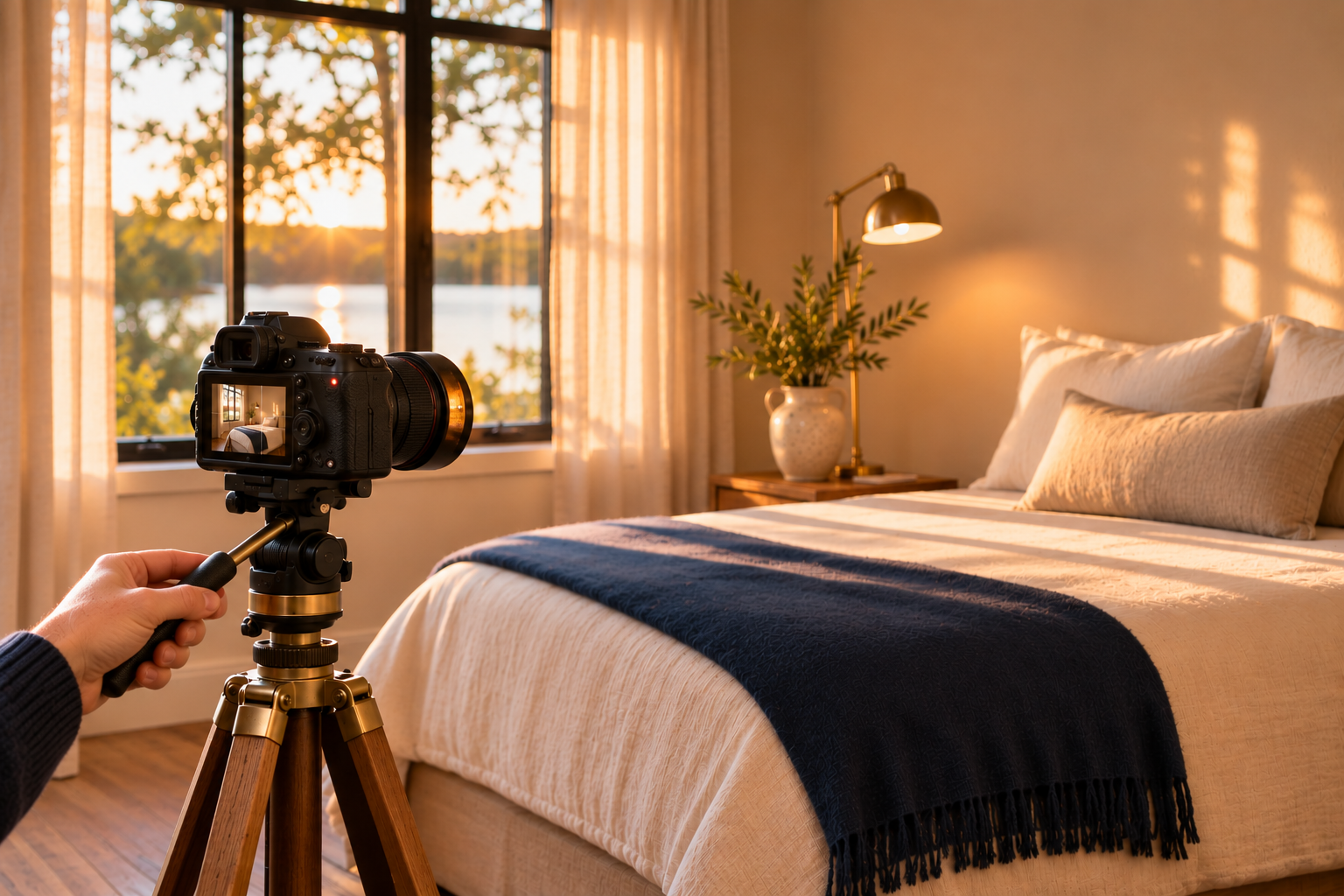
Hotel Photography Strategy for More Direct Bookings
In short: A hotel photography strategy for more direct bookings plans every photo around a question a guest asks before booking, then places it beside the matching rate and Book Now button on your own website, and keeps the same honest images on Google, so guests feel sure enough to book with you instead of an online travel agency.
- Guests book the stay they can picture. If a booking site shows your rooms more clearly than your own website does, that booking site is likely to get the reservation.
- Plan the shoot from a list of guest questions, such as "How big is the room?" and "What does the view look like from bed?", not from a list of pretty angles.
- Place each room's photos right beside that room's rate and booking button, and check every gallery on a phone before it goes live.
- Google recommends hotel photos at 2048 x 1366 pixels, with a 1024 x 683 minimum, in JPG, WEBP or PNG.
- Old, staged or stock photos may cost you more than bookings. When the room doesn't match the picture, guests tend to say so in their reviews.
You open Expedia to check your own listing, and there it is: your best suite, shot in perfect light, sitting above a "Reserve" button. Then you open your own website and find the same suite in a dim photo from 2021, three clicks away from the rate. No wonder the booking site keeps winning.
You've likely tried to fix this before. Maybe you paid for a shoot that came back beautiful and changed nothing. That's usually not the photographer's fault. For independent hotels, photography should never be treated as a standalone creative exercise. It's part of how your brand communicates value, builds trust and influences booking decisions. The images on your website, Google Business Profile and booking platforms all shape the impression guests form before they arrive. When those images work together with clear messaging and an easy booking experience, they become a valuable part of your direct booking strategy. It's less about how good the pictures look and more about which photos you take, where they appear and whether they answer the questions guests have at the moment they're deciding to book.
This guide is for independent boutique hotels and inns with a few years behind them, a loyal guest base and direct bookings that have stopped growing while commission bills keep climbing. It shows you how to plan a photography shoot, position your images across your website and Google Business Profile, and use them consistently across your digital channels so more guests feel confident booking directly with you.
Definition, hotel photography strategy: a plan that decides which photos your property needs, based on the questions guests ask before they book, and where each photo appears on your website, Google Business Profile and social media accounts, so the images help a guest choose to book directly.
Why guests book your rooms on someone else's site
A direct booking is a reservation made on your own website or booking engine, rather than through an online travel agency (OTA) such as Booking.com or Expedia. You keep the full rate, you own the guest relationship, and you can welcome them back next year without paying a commission again.
Guests want to book with you, too. A 2025 study published in the Journal of Hospitality and Tourism Technology found that mismatched images and text on hotel websites reduced perceived trustworthiness and negatively influenced guests' attitudes towards those websites. Trust comes first. And photos are one of the quickest ways your website earns that trust, or loses it.
What a direct booking is worth to you
The gap is real money. SiteMinder's look at hotel bookings found that hotel websites produced an average of US$519 per booking in 2024, more than 60% above the US$320 average for bookings made through OTAs. Every guest who looks at your rooms on your own website and then books them somewhere else takes part of that difference with them.
OTAs know how much photos matter. Their listing pages lead with large, sharp, swipeable galleries. If your own site makes a guest squint at small thumbnails or hunt for the bathroom, you're asking them to trust you with less information than a booking site gives them.
Plan the shoot around guest questions
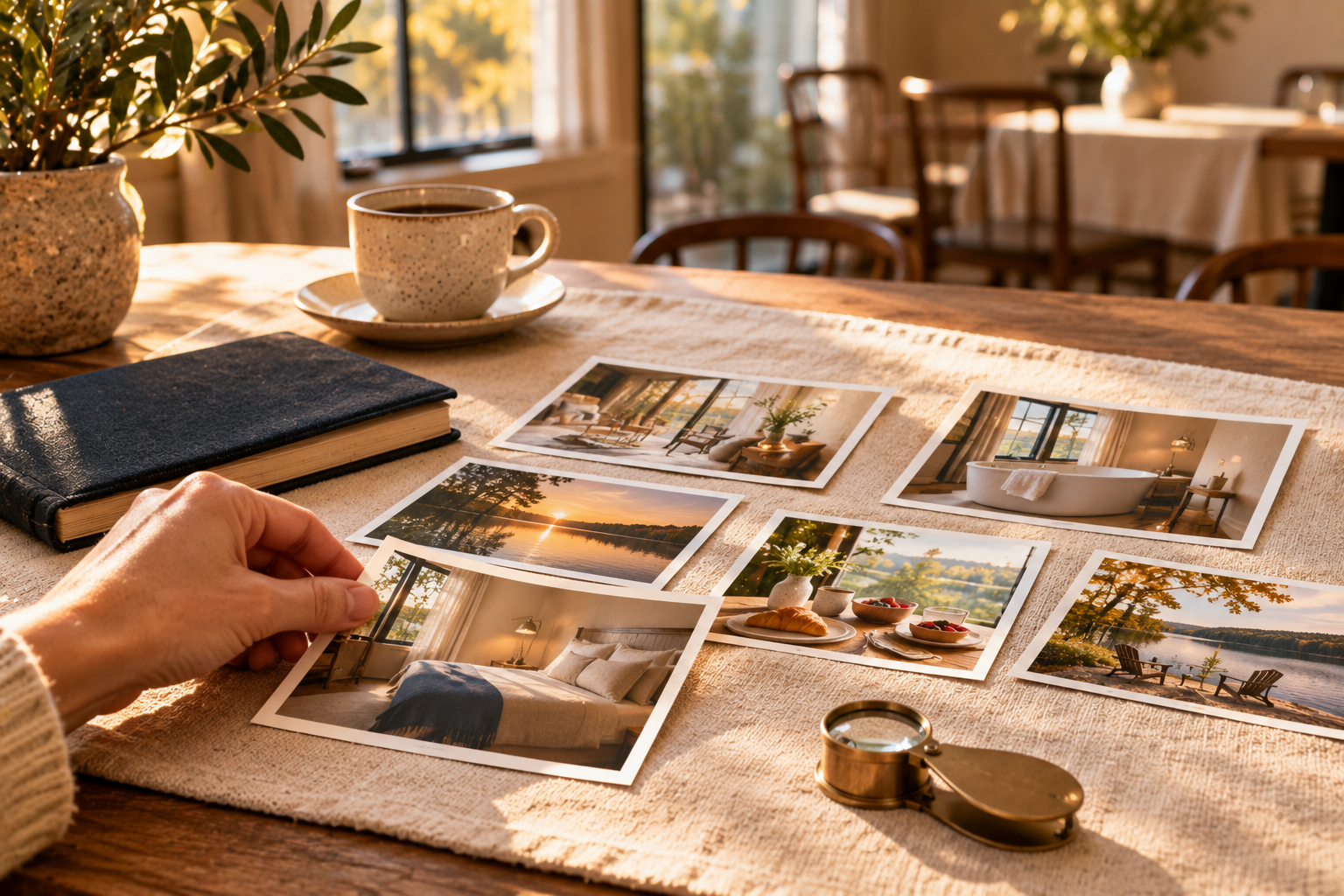
Most hotel shoots start with a photographer's list: exterior at dusk, lobby, a few rooms, the pool. A strategy starts with your guest instead.
Name the guest and the feeling first
Before anyone picks up a camera, write down who books with you directly and what they're hoping to feel. A couple escaping Toronto for a quiet weekend wants soft morning light, an unmade bed with a tray of coffee, and an empty trail at dawn. A wellness guest wants space, calm and a clear look at the sauna with a short walk to a treatment room. A family wants to see where the kids will sleep.
Your photography should reflect the position you want your property to occupy in the market. A boutique lakeside retreat, a luxury Nordic spa and a family-friendly independent resort should not all look the same. Before planning a shoot, identify what makes your property different, who you want to attract and what experience you want guests to associate with your brand.
Then turn that understanding into direction your photographer can follow: the time of day, the styling, the colour palette and how polished or relaxed the shots should feel. If your boutique hotel messaging promises "slow mornings by the lake," your photos need to show a slow morning by the lake. Every image should reinforce the experience you're promising and give potential guests a reason to choose your property over another.
A shot list that answers what guests ask
Every image should earn its place by answering something your front desk hears every week. Use this as a starting point:
| Shot | Guest question it answers | Where it belongs |
|---|---|---|
| Your signature experience, such as the hot tub at dusk or breakfast on the porch | "What will this stay feel like?" | Homepage and Google Business Profile cover |
| Each room type, from two or three angles | "What exactly am I booking?" | Each room page, beside its rate |
| The bathroom, the desk and the view from the bed | "Will this be comfortable and practical?" | Room galleries |
| Dining, spa, trails and nearby sights | "What else is here, or close by?" | Experience and package pages |
| The entrance, parking and accessible features | "Will this work for me?" | Amenities and FAQ pages |
Notice what's missing: the generic "lobby wide shot" nobody asked for. If a photo doesn't answer a guest question, it probably belongs in your archive, not your gallery.
Put each photo where the decision happens
Your homepage sets the mood, but it rarely closes the booking. The room pages, the package pages and the booking engine do that work. So your strongest, most honest photo of each room should sit right next to that room's description, nightly rate and Book Now button. A guest sees exactly what they're getting at the moment you ask them to pay.
Good photos also answer questions before anyone has to email you. Is there a tub or just a shower? Can I see the lake from the bed? Is the pool covered in October? Each answered question is one less reason to leave your site and go looking on a booking site.
Most of this browsing happens on a phone, often in bed or on a lunch break. Build galleries a guest can swipe with one thumb, keep file sizes small so they load fast, and test every page on your own phone before it goes live. If your gallery works but the booking step still loses people, our post on why hospitality websites lose bookings on mobile covers what to fix next. Once your updated photography is live, look beyond how the website looks. Pay attention to whether visitors are engaging with room pages, clicking through to your booking engine and completing reservations. Compare your direct booking conversion rate before and after the changes, and monitor how much of your booking revenue comes through your own website versus online travel agencies. These measurements help you understand whether your photography is supporting better booking decisions or simply making the website look more attractive.
Your photos travel further than your website
Many guests see your photos long before they reach your site. They see them in Google Search and Maps, in Google's hotel results, on Instagram, and more and more often inside the answers AI assistants give. The same set of photos should show up everywhere, telling the same story. When your website, Google Business Profile and social media accounts each show a different-looking property, guests aren't sure which one to believe.
Google's own numbers show why your profile deserves the same care as your website. Its 2026 Business Profile best practices playbook reports that 90% of people are more likely to visit a business that has photos on Google Search and Maps, and that businesses with photos get 35% more clicks through to their websites. Those are clicks to your website, where a direct booking can happen. AI search tools and assistants such as ChatGPT and Gemini are also becoming a trusted first stop for travellers, which is why every place your photos appear now matters.
Use Google's photo specs
Google's photo recommendations for hotels are clear: 2048 x 1366 pixels is the recommended size, 1024 x 683 is the minimum, files can be up to 10 MB, and JPG, JPEG, WEBP and PNG are all accepted. Ask your photographer to deliver full-size files for Google and lighter, compressed versions for your website so your pages still load quickly.
Name and describe each photo the way a guest would
- File names: say what's in the photo, such as
king-suite-fireplace-lake-view.jpg, notIMG_4471.jpg. - Alt text: describe the image in one plain sentence, such as "King suite with a stone fireplace and a view of the lake." It helps guests who use screen readers, and it gives search engines and AI tools words to understand the room.
- Captions where they help: "Every room on the second floor faces the water" answers a question no photo can answer on its own.
A 20-room inn, before and after
Picture a 20-room inn in Prince Edward County. It has strong reviews, a busy summer, and a website full of wide exterior shots and one photo per room category. Direct bookings have been flat for two years while the OTA share creeps up.
The owners plan a new shoot around four themes: each room type, the dining room at breakfast, the local wineries and beaches, and the inn in each season. They rebuild the site so every room's photos sit beside its rate and booking button, put the winery images on the packages page, and update their Google Business Profile with the same set of photos the same week.
Before making these changes, the owners establish a performance baseline. They track direct booking conversion rates, room-page engagement, booking engine activity and the percentage of reservations coming through OTAs. They review these figures monthly against the previous year, accounting for seasonal booking patterns and looking at performance over a full season rather than a single weekend.
That last step matters. A new hero image can feel like a win on day one, but the real test is whether more people who visit the website end up booking directly. Measuring the results helps the owners understand whether their photography and website improvements are supporting better booking decisions and where to focus their next marketing investment.
Photo habits that hand bookings to the OTAs
The costliest mistake is a gap between what your photos promise and what guests find. These are the habits we see most often:
- Photos of rooms that no longer exist. You renovated in 2023, but the website still shows the old carpet. Guests notice, and they may say so in a review.
- Stock photos and borrowed scenery. A guest who books for a view should see your view, not a generic sunset.
- One photo per room type. If your rooms differ in a way that changes the price, each one needs its own photos.
- A different look on every platform. Warm and moody on Instagram, flat and bright on your website, five years old on Google. It reads like three different hotels.
- Galleries too heavy for a phone. Beautiful photos that take eight seconds to load are photos most guests won't wait for.
Google's own hotel guidance says photos help tell the authentic, compelling story of your property. The independent hotel that wins the direct booking isn't always the prettiest one. Often it's the one whose photos a guest believes.
How Wondering Concierge turns photos into bookings
Photography is only one part of a stronger hospitality marketing strategy. Your brand positioning, website experience, search visibility and customer journey all influence whether a potential guest chooses to book with you.
Wondering Concierge looks at how these elements work together. We help independent hospitality businesses build a consistent brand, improve their digital presence and create marketing strategies that support sustainable growth. That means looking beyond individual marketing activities and understanding how every touchpoint contributes to the guest's decision.
Find the gaps first
Our Concierge Brand Audit puts your website, booking engine, Google Business Profile, OTA listings and social media accounts side by side. We look at where your photos tell a different story, which guest questions go unanswered, and where guests drop off before they book. You get a short, ranked list of what to fix first, which also becomes the brief for your next shoot.
Then make every channel tell the same story
- Brand strategy: the guest, the feeling and the visual direction your photographer works from.
- Website design: room and package pages built so each photo sits beside its rate and booking button, and galleries that load fast on a phone.
- Google Business Profile: the same honest photos, refreshed each season, with your details kept current.
- Search Everywhere Optimization: file names, alt text and listings set up so Google, AI search tools and social media platforms can understand and show your property.
This work compounds. A boutique Nordic spa client grew its customer base by an average of 114% year over year across six months of working together. That result came from the whole brand and visibility effort, not from photos alone, but clear, honest images were part of every channel it touched.
Because Wondering Concierge founder Miles Harding came to marketing from the hospitality floor, we hold every photo to one test: would a guest who booked from it walk into the room and feel they got what they were promised? If not, it doesn't make the gallery.
Before your next shoot
Take an honest look at the photos you have now. Do they show the stay you want guests to remember? Does each room have its own photos next to its own rate? Would a guest see the same property on Google, Instagram and your website?
Better hotel photography starts with understanding your guests, but its value extends far beyond the images themselves. When your photography reflects your brand, answers guest questions and works alongside a well-designed website and consistent online presence, it becomes part of a stronger booking experience.
The goal isn't simply to have a more attractive gallery. It's to help potential guests understand what makes your property worth choosing, feel confident in their decision and book directly with you.
How many photos should each hotel room type have?
Aim for at least three to five per room type: the full room, the bed, the bathroom, the view and one detail that sets it apart. If two rooms differ in price, size or view, give each one its own set so guests know exactly what they're booking.
Do better hotel photos help with direct bookings?
They can. Photos help guests trust what they're booking, and trust is a big reason people book direct. Photos work best when each one answers a guest question and sits beside the matching rate and Book Now button on your own website.
What size should hotel photos be for Google?
Google recommends 2048 x 1366 pixels, with a minimum of 1024 x 683 and a maximum file size of 10 MB. It accepts JPG, JPEG, WEBP and PNG. Use lighter, compressed copies on your website so pages still load quickly on a phone.
How often should a boutique hotel update its photos?
Reshoot whenever a room, amenity or package changes, and refresh seasonal photos every year if your property looks different in winter and summer. Update your website, Google Business Profile and booking sites the same week.
Can I use the same photos on my website and booking sites?
Yes, and it often helps, because guests see one consistent property everywhere. Many hotels keep their very best room and experience photos on their own website, so guests who compare get the fullest picture when they book direct.
The first step is a free 30-minute Clarity Call. No pitch deck. You'll leave with at least one clear observation about where your brand is losing visibility or momentum, and one direction for what to fix first.
Miles runs every Clarity Call personally, with no obligation to continue after the call. Book Your Clarity Call Our deepest tier, an embedded strategic marketing partnership, is reserved for six founders at a time.This blog collection is written by Miles Harding and the Wondering Concierge team for the benefit of readers to be able to grow their business and get found online by more of their dream customers. The team includes human members with learned / lived experiences and expertise, as well as trained AI team members who assist with the creation and publication of this blog content. The team monitors Google and other guidelines for continued knowledge to help with SEO and AI usage. If you have any questions regarding the humans in the loop and how AI is used to follow these guidelines, contact Wondering Concierge at [email protected].