

How Local SEO Works for Small Business
- Local SEO targets searches with geographic intent, like "chiropractor Burlington Ontario," and it is the highest-return search investment for local wellness and hospitality businesses.
- Google ranks local businesses on three factors: relevance, distance, and prominence. Only distance is outside your control.
- Review recency matters more than volume. A business with 40 recent reviews will usually outrank one with 100 old reviews.
- The single highest-leverage 30-minute task available to you today is completing every empty field on your Google Business Profile.
You have heard "local SEO" so many times that it has started to sound like background noise. Every agency mentions it. Every marketing blog covers it. And yet most wellness and hospitality business owners in Ontario could not explain, with any confidence, what Google actually looks at when deciding who shows up first for a local search.
That matters. Because if you do not understand what drives local search rankings, you cannot make good decisions about where to invest your time and money. You end up buying tactics that may or may not be connected to the thing that actually determines your position.
Here is the real answer. Local SEO works by ranking businesses on three factors Google has confirmed: relevance, how well your Google Business Profile and website match the search, distance, your proximity to the searcher, and prominence, your reviews and online visibility. Relevance and prominence are within your control while distance is not.
No jargon, no course to buy, no vague gestures toward "content strategy." Just what Google uses to rank local businesses and what it means for you.
What Local SEO Is and How It Differs from Regular SEO
Regular SEO, sometimes called national or organic SEO, is the practice of making your website appear in search results for broad terms. A blog post that ranks for "how to manage anxiety" or "what is physiotherapy" is doing regular SEO. It can reach people anywhere in the world and has no geographic targeting.
Local SEO is different in a critical way: it targets searches with geographic intent. According to Google, 46% of all searches have local intent. When someone searches "yoga studio near me," "chiropractor Burlington in Ontario," or "massage therapy in Oakville," they want a local result. Google knows this and responds with local results, primarily the Google Maps pack and locally relevant websites, rather than purely organic content.
For almost every wellness clinic, studio, fitness business, and boutique hospitality brand in Ontario, local SEO is the highest-return search investment. Your clients are local and your appointment slots are finite. A yoga student in Oakville who finds your studio through local SEO for small businesses is infinitely more valuable than a generic web visitor from another country who will never book.
The Three Factors Google Uses to Rank Local Businesses
Google has been relatively transparent about this, as laid out in its own documentation on how local search works. Local search rankings are determined by three factors: relevance, distance, and prominence. Understanding each one tells you exactly what you can and cannot control.
Relevance
Relevance is the degree to which your Google Business Profile and website match what the searcher is looking for. When someone searches "prenatal yoga Oakville," Google asks: does this business's profile clearly describe prenatal yoga? Does the website mention prenatal yoga in Oakville specifically? Are the services listed in the GBP aligned with this search? Relevance is almost entirely within your control, through how completely and specifically you have described your services.
Distance
Distance is how close your business is to the person searching or to the location specified in the search. You cannot change where your clinic is but what you can do is make sure Google's understanding of your location is accurate, complete, and consistent across every platform. A mismatched or inconsistent address information across directories, your website, and your GBP will actively hurt your local ranking.
Prominence
Prominence is how well-known and trusted your business appears to be, based on online signals. This is driven by your review volume and recency, the number of places your business is listed online, how active your GBP is, and how much high-quality web content references your business. Prominence is the factor that separates businesses at similar distances with similar relevance signals.
What Google Business Profile Actually Does
The single most impactful local SEO asset for a wellness or hospitality business in Ontario is not your website. It is your Google Business Profile.
Your GBP is what drives your placement in the Google Maps pack: those three listings that appear at the top of local search results, above the organic website results, with star ratings, photos, and hours. A potential client searching "chiropractor in Hamilton" is looking at the map pack, not scrolling down to organic website listings. The map pack gets the overwhelming majority of clicks for local searches.
Your GBP also feeds Google's AI Overview and is the primary data source that AI platforms like ChatGPT and Perplexity pull from when making local recommendations.
A GBP that drives new clients looks like this: every service listed with a specific description, recent photos updated at least twice a month, a post in the last 30 days, a direct booking or contact link, a consistent business name and address that matches every other platform you are listed on, and a response to every review you have received.
Most wellness businesses in Ontario have a GBP and most have not done any of this. In a typical Google Business Profile audit, we find the same three gaps on almost every clinic or studio we look at: services listed without specific descriptions, photos that have not been touched in six months or longer, and reviews that were never responded to. The gap between a half-complete GBP and a fully optimized one is measured in positions on the map and appointments on the calendar.
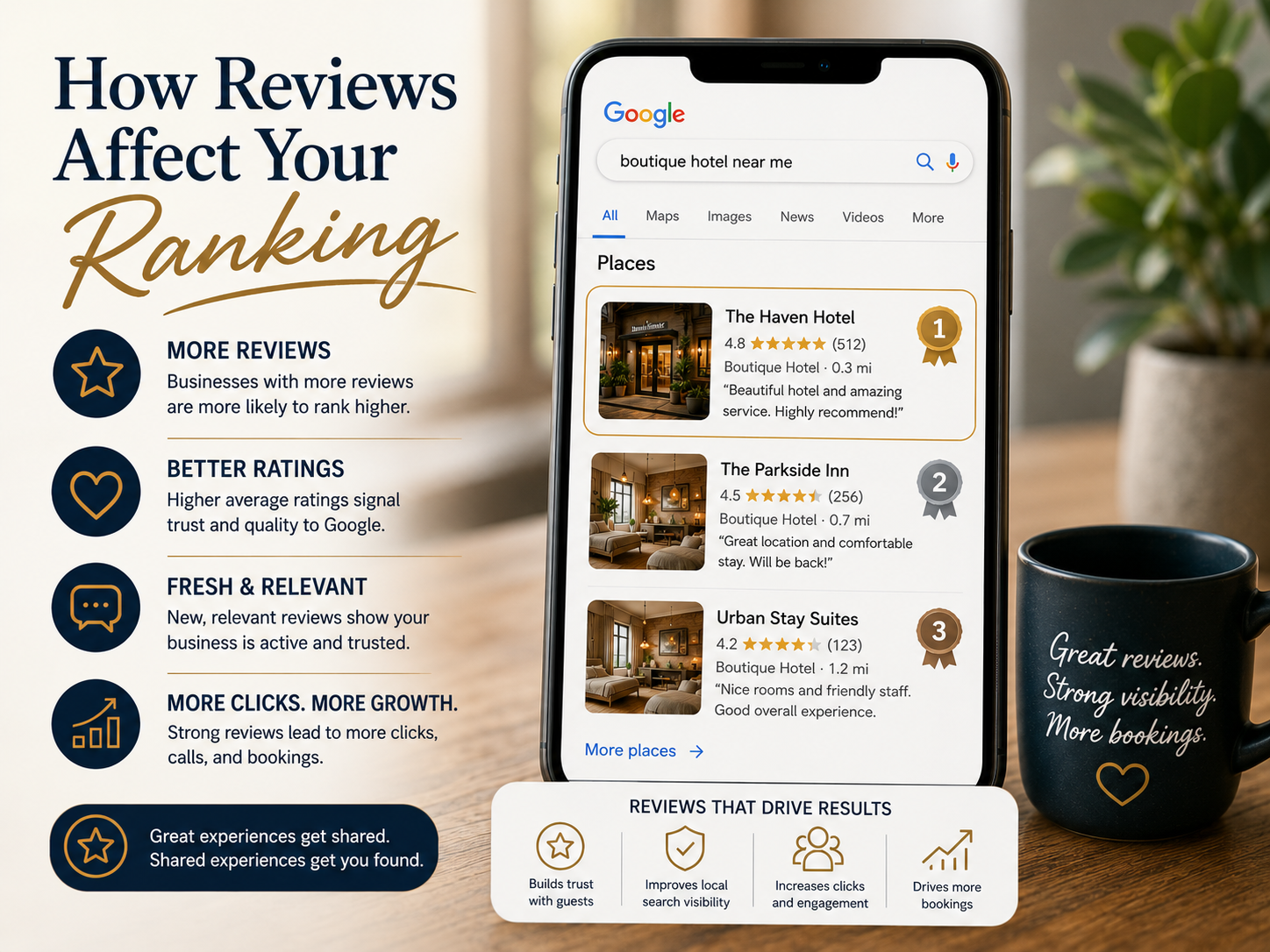
How Reviews Affect Your Ranking
Reviews are the most misunderstood part of local SEO, and also one of the most impactful. Independent research from BrightLocal's Local SEO Industry Report consistently ranks review signals among the top local ranking factors year over year.
The Three Review Factors
The three review factors Google weighs are: total review count, average star rating, and review recency. Of these three, recency is the one most businesses are losing ground on without realizing it.
A clinic with 100 five-star reviews and the last one posted seven months ago will consistently lose ranking position to a clinic with 45 reviews and three posted in the last 30 days. Google interprets recent review activity as evidence that the business is actively serving clients. A long gap in reviews signals that activity may have slowed or that the business is not prompting reviews, which Google treats as a lower prominence signal.
The practical implication: you need a simple, ongoing system for generating reviews, not a one-time push. The right moment to ask is immediately after a positive interaction, a great appointment, a client milestone, a session that exceeded expectations. A personal ask with a direct link produces far better conversion than a mass email.
Why Responding to Reviews Matters
Responding to reviews also matters. Review response activity is a ranking signal. A business that responds to every review, positive and critical, signals to Google that the owner is present, engaged, and accountable.
What Happens When Someone Searches Near You vs. Far Away
This is something most business owners wonder about and rarely get a clear answer on.
Google personalizes local search results based on the searcher's location. When someone two blocks from your clinic searches "yoga studio near me," your proximity advantage is significant. When someone three kilometres away searches the same term, your advantage decreases and relevance and prominence signals matter more.
This is why the content on your website and GBP needs to do two things: signal your precise location clearly for the high-proximity searcher, and build enough relevance and prominence that you remain competitive for the moderate-distance searcher.
Local landmark references, neighbourhood names, nearby transit stations, and community anchors help with the first, something we cover in more depth in our local landmark SEO strategy for Ontario businesses. Strong reviews, active GBP posting, and condition-specific website content help with the second.
How AI Search Is Layered on Top of Local SEO
Traditional local SEO determines your position in Google Maps and organic search results. AI search is a separate, newer layer that operates differently and is becoming increasingly important for Ontario wellness businesses. We call the discipline of building visibility across all of it Search Everywhere Optimization.
When a potential client asks ChatGPT or Perplexity "what is the best holistic health practitioner in Burlington for digestive issues," the AI does not pull from Google rankings. It synthesizes what it can find about local practitioners from their websites, their GBP data, their review content, and any published information about them online.
A business that has invested in local SEO, with a complete GBP, condition-specific website content, strong reviews, and active directory listings, gives AI platforms the rich information they need to make a confident recommendation. A business with thin online presence does not appear in AI recommendations regardless of how well it ranks on Google Maps.
This means the work you do for local SEO also builds your AI search visibility, but only if your content is specific, structured, and comprehensive enough for AI platforms to synthesize.
Where to Start If You Are Behind
If you have been reading this and realizing your local SEO presence is not where it needs to be, here is the honest first step.
Log into your Google Business Profile and spend 30 minutes completing every empty field. Add your services with specific descriptions, update your photos and respond to any unanswered reviews. Post one update today.
That single session will produce more local search improvement than most of what agencies sell as "SEO packages" because it directly addresses the three factors Google uses to rank you.
When you are ready to go further, a Clarity Call
is the fastest way to find out exactly where your gaps are and what to fix next.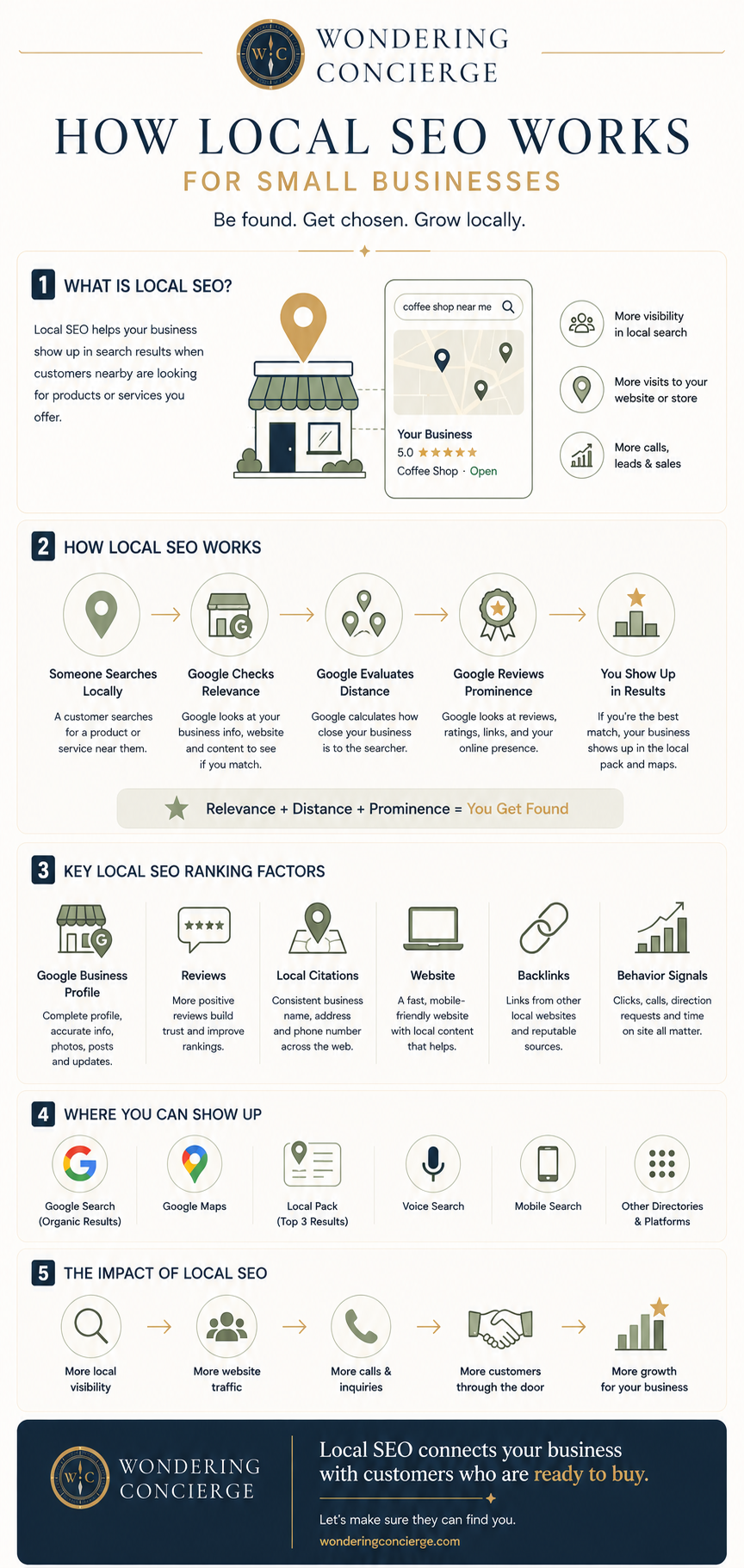
Book a free Clarity Call. In 45 minutes, we look at your current digital presence, identify the biggest gaps, and give you a clear picture of what it would take to start showing up where your clients are searching.
No pitch. No commitment. Just clarity.
Book Your Clarity CallFrequently Asked Questions
What is local SEO and why does it matter for a wellness clinic in Ontario?
Local SEO is the practice of making your business visible to people in your area who are searching for what you offer. For an Ontario wellness clinic, yoga studio, or hospitality brand, it is the highest-return search investment because it puts you in front of local clients at the exact moment they are ready to book. Google Maps rankings, driven by your Google Business Profile, are where the majority of local search clicks happen. If you are not in the top three results there, you are largely invisible to new clients who are actively searching.
What three things affect your Google Maps ranking the most?
Relevance, distance, and prominence. Relevance is driven by how completely and specifically your Google Business Profile and website describe your services. Distance is your proximity to the searcher. Prominence is driven by your reviews, your GBP activity, and how widely your business information is distributed across the web. You cannot change your location, but relevance and prominence are almost entirely within your control.
Why does my competitor show up before me on Google Maps even though they are further away?
Because their relevance and prominence signals are stronger than yours. Google weights distance heavily, but relevance and prominence can overcome a proximity disadvantage when they are significantly stronger. Your competitor likely has a more complete GBP, more recent reviews, and more active posting than you do. These are all fixable.
Do online reviews actually affect my Google Search ranking?
Yes, directly. Reviews are one of the primary signals Google uses for local rankings. Total review count, average rating, and review recency all influence your position. More importantly, review recency matters more than volume. A business with 40 recent reviews will outrank a business with 100 old reviews in most local searches. Responding to every review also signals to Google that your business is active and accountable.
How is local SEO different for a small wellness clinic vs. a large hospital or chain?
Local SEO actually favours smaller, community-embedded businesses in many ways. A large hospital or chain ranks for institutional, broad-topic searches. A small clinic can outrank them for specific, neighbourhood-level searches by building deep relevance signals for a defined geographic area. The local landmark strategy, condition-specific content, and active GBP management give smaller practices tools that larger organizations cannot replicate at scale.
This blog collection is written by Miles Harding and the Wondering Concierge team for the benefit of readers to be able to grow their business and get found online by more of their dream customers. The team includes human members with learned / lived experiences and expertise, as well as trained AI team members who assist with the creation and publication of this blog content. The team monitors Google and other guidelines for continued knowledge to help with SEO and AI usage. If you have any questions regarding the humans in the loop and how AI is used to follow these guidelines, contact Wondering Concierge at [email protected].