Keep Your Brand Consistent for AI Search: A Guide for Hospitality and Wellness
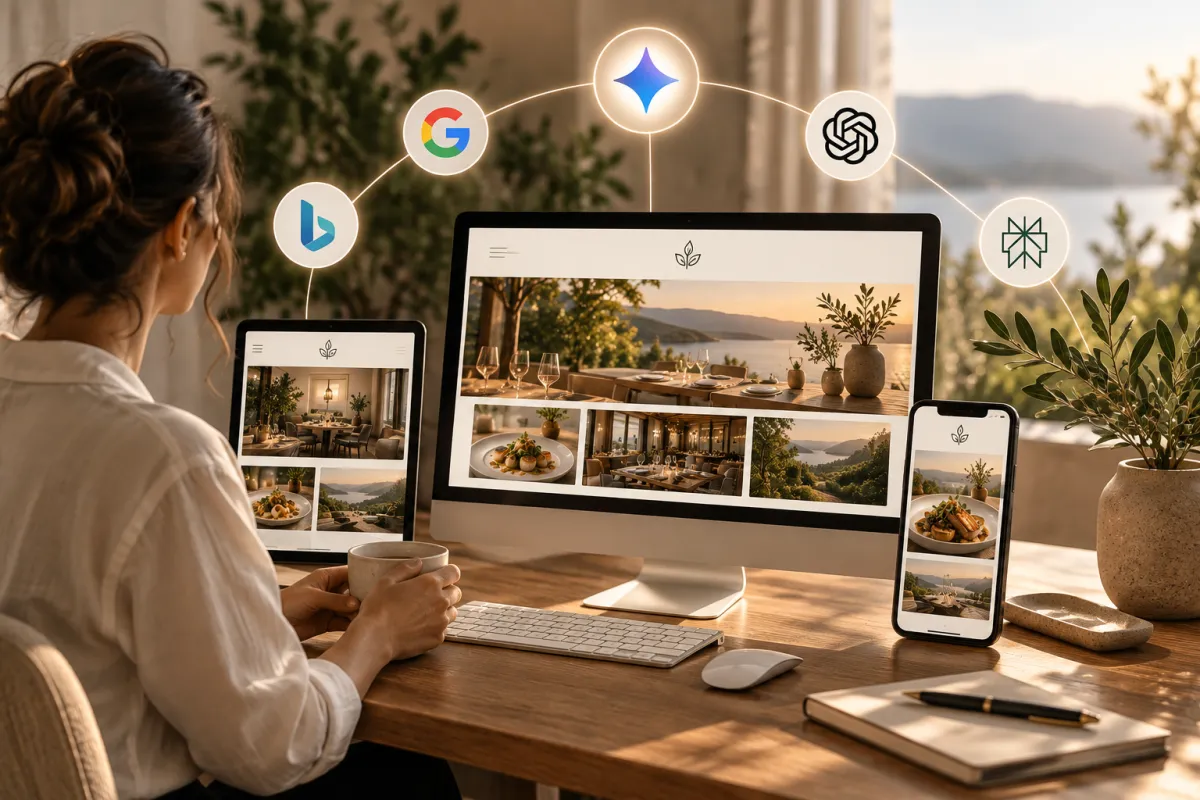
In short: AI search builds a picture of your brand from many places at once, your website, your Google Business Profile, directories, maps, review sites, and your social media accounts. When those sources say the same thing, you get recommended. When they disagree, the system has weaker evidence about what is true, and you get left out.
- No single page decides how AI search describes you. It reads several sources and looks for the ones that agree.
- AI tools are now the third most popular way people find local businesses, after a jump from 6% to 45% in one year.
- Guests spot small errors fast. An old phone number or last season's hours reads as carelessness before anyone walks in.
- Consistent does not mean identical. Keep the same facts and the same promise, and let the length and format change by platform.
- Start with your Google Business Profile, clear out duplicate listings, then make your schema markup repeat what the page already says.
AI search does not find your brand in one place. It puts you together from pieces: your website, your Google Business Profile, directories, maps, review platforms, and your social media accounts. Each one is a small claim about who you are. The system compares them and decides how sure it is.
That is different from how most brands are prepared for. You can have a beautiful website and still be described wrongly by a tool your next guest trusts, because a listing you forgot about five years ago says something else. If your sources disagree, the safest thing a search system can do is recommend someone clearer instead of you.
And this matters more now because people are actually using AI to decide where to go. BrightLocal's 2026 survey found that the number of consumers using ChatGPT and similar AI tools for local recommendations climbed from 6% to 45% in a single year, which makes them the third most popular way people find a local business. The same research found that 40% of people now trust AI platforms to recommend a business to them. Before your next guest ever visits your website, they may already be reading an AI-generated summary of your brand.
Why consistency matters more in AI search
Search visibility depends on matching signals
AI-driven search tools rely on compounding facts. Every time two sources agree on your phone number, the system gets a little more sure. Every time they disagree, it gets less sure. If your business name, category, phone number, hours, or website address differ from one platform to the next, there is weaker evidence about what is true. That can make a tool less willing to put you forward for local and branded search queries.
Google is pretty clear about what it wants here. Its guidelines tell you to represent your business the way it is consistently represented and recognized in the real world, across signage, stationery, and other branding, and Google decides how to show your details using your profile plus information from other sources.
This is really important because the profiles you did not build are not a second thought anymore. A guest may never reach your website. They could find you through a directory, a map listing, or an AI answer that pulls information from several places. Whatever those sources say about your brand is what you said, as far as the reader is concerned.
Guests notice inconsistencies immediately
Hospitality and wellness brands get judged on small things. A room description that does not match the photos. A phone number that rings somewhere else. Hours that still show last summer's schedule. Missing check-in information. None of that is a big failure on its own, and all of it reads the same way to a guest deciding between you and somewhere else. It reads as a place that does not keep track.
The trust question has moved too. BrightLocal found that 82% of people now read AI-written review summaries, and 23% are willing to decide on that summary alone without reading further. AI search such as ChatGPT and Gemini, and more, is beginning to build trust with humans as their own trusted source, and this is why all discovery channels matter so much. A summary built from conflicting sources will read as a hedge, and a hedge loses to a clear answer about the property down the road.
What brand consistency includes
Many teams treat consistency as a design job: the logo, the colours, and the fonts. Those matter for people, but for AI search, the harder problem is whether the facts about your business and the way you describe it stay consistent across all the places it can find you online.
Definition, brand consistency for AI search: the same core facts about your business, your name, address, phone number, hours, category, and description, appearing the same way everywhere a search system can read them, so nothing you publish contradicts anything else you publish.
| Element | What should stay the same | Why it matters for AI search |
|---|---|---|
| Business name | The exact name you use in public | Stops the system treating you as two businesses |
| Name, address, phone number | One format, written the same way every time | These are the details people check first, so they carry the most weight |
| Hours | Regular, seasonal, and holiday hours | Wrong hours are the fastest way to turn a ready guest into a bad review |
| Primary category | The same core description of what you are | Decides which searches you are considered for at all |
| Description | The same promise, positioning, and tone | Helps a system describe you the way you would describe yourself |
| Website address | One address that everything points to | Keeps your authority in one place instead of splitting it |
| Photos | Current images that match the property today | Sets expectations a guest can confirm when they arrive |
| Structured data | The same facts your page already shows | Lets the search engines read your details without guessing |
Practical ways to keep your brand aligned
Write down your core details once
Start with a single record that everything else copies from. Put your exact business name in it, the address in one agreed format, the main phone number, the booking link, a short description, your primary category, the words you use for your amenities, and your hours. Keep it somewhere your front desk can reach, because the person answering the phone is often the one who notices a detail has gone stale.
Then check your Google Business Profile against it first. That profile is one of the clearest sources search systems use to work out what a local business is, and you can update hours, contact details, photos, and services directly. Treat it as something you maintain, like your rooms, rather than something you set up once and forget.
Clear out duplicate and conflicting profiles
Duplicates are the quickest route to contradicting yourself. They split your reviews, show different details, and leave both guests and search systems with two answers. In hospitality and wellness they turn up after a rebrand, after an ownership change, after a move, or when a booking platform creates its own version of your property without asking.
Google states plainly that multiple profiles for the same business may mislead customers and are against its policies, and duplicate profiles do not show in Search or Maps. Search your property name, your address, and your old trading name, then claim, merge, or remove what you find. Do this before you spend anything on optimization, because tidying up the record you already have is usually the cheaper win.
Keep your messaging consistent, not identical
Consistency does not mean pasting the same paragraph into every field on the internet. It means keeping the same promise, the same positioning, and the same facts wherever you appear.
Say your website sells quiet, design-led stays for couples on a weekend away, and a directory entry describes you as a budget family property with a list of generic amenities. A person can hold both of those in their head and pick the one that sounds right. A search system reads mixed signals about who you are for, and becomes less likely to recommend you for either. Change the length and the format to suit each platform. Keep the story and the details the same.
Use structured data to repeat what your brand says
Structured data is a small block of code that states your details in a form that search engines can read without interpreting your page design. For a local business, Google's LocalBusiness documentation covers things like your hours, your departments, and your reviews. For properties, schema.org has a dedicated Hotel type that gives search systems a clearer frame for the details specific to lodging.

The point of it is agreement. Your markup should never introduce different hours, another version of your name, or contact details that are not on the page. It earns its keep by confirming what you are already publishing everywhere else. If it contradicts your own page, it can create more confusion instead of less, you’ve essentially given the system another version of the story to figure out.
How Wondering Concierge helps with this
Keeping a brand consistent across a website, a set of listings, review platforms, and technical markup is rarely one person's job, which is usually why it drifts. Nobody owns it, so it gets done when something breaks.
Our work joins those pieces up rather than treating them separately. That means brand strategy that gives you a documented voice instead of one held in someone's memory, website design and copy that state your facts clearly enough for a search engines to quote, Google Business Profile work including duplicate cleanup, and Search Everywhere Optimization so you are legible to Google, to AI assistants, and to social search at the same time. Content strategy and CRM and automation sit on top of that, so the guest who finds you gets a reply.
Most engagements start with a Concierge Brand Visibility Audit, because the first useful thing is usually a plain list of where your own sources disagree with each other. In one engagement, a wellness and boutique Nordic spa client grew its customer base by an average of 114% year over year across six months of working together. That came from the whole visibility and brand program rather than any single fix, and consistency was the part that made everything else worth doing. There is no point being recommended if the details that reach the guest are wrong.
The takeaway for hospitality and wellness brands
AI search rewards clarity. The brands that get described accurately are the ones giving consistent information everywhere: same name, same details, same positioning, same promise about the stay.
If you want somewhere to start, book an hour this quarter and check four things against each other. Your website, your Google Business Profile, your main directory listings, and your schema markup. Look for small inconsistencies. Are your hours different in one place? Does your property name have an extra word somewhere? Do you have duplicate listings? Are you still showing photos of rooms or spaces that have since been renovated? Does one description make your property sound completely different from another? The corrections are usually small. They are worth more than they look, because every correction gives both search systems and potential guests a clearer, more consistent picture of your brand.
How do I keep my business listings consistent?
Keep one written record of your public details and check every major profile against it on a set schedule. Review your website, Google Business Profile, main directories, and social media bios each quarter, and again straight after any change to hours, phone numbers, or branding.
Does AI search really use my Google Business Profile?
Yes. Your profile is one of the clearest sources a search system has for your name, hours, category, and location, and those details flow into the answers AI tools give. If your profile disagrees with your website, you have given both a reason to be less certain about you.
What happens if I have duplicate business profiles?
They split your reviews and show competing details. Google states that multiple profiles for one business may mislead customers and are against its policies, and duplicates do not appear in Search or Maps. Claim, merge, or remove them before spending on anything else.
Does every platform need the same wording?
No. Keep the same facts, promise, and positioning, then change length and format to suit each platform. A short map listing and a full website page can read differently and still agree. What you cannot do is describe a different business in each place.
How often should I check my brand details?
Once a quarter as a full pass, plus a check any time something changes. Hours, phone numbers, and photos drift fastest. Booking platforms can also create listings for your property without telling you, so search your own name and address periodically.
The first step is a free 30-minute Clarity Call. No pitch deck. You'll leave with at least one clear observation about where your brand is losing visibility or momentum, and one direction for what to fix first.
Miles runs every Clarity Call personally, with no obligation to continue after the call. Book Your Clarity Call Our deepest tier, an embedded strategic marketing partnership, is reserved for six founders at a time.